Case Report
Purple Urinary Bag Syndrome in a Patient with Acidic Urine: A Case Report
Paolo Vigne1, Rodrigo Aparicio1
doi: https://doi.org/10.5195/ijms.2026.4166
Volume 14, Number 2: 103-106
Received 24 11 2025; Rev-request 05 02 2026; Rev-request 17 03 2026; Rev-recd 11 02 2026; Rev-recd 21 03 2026; Accepted 25 06 2026
ABSTRACT
Background:
Purple urine bag syndrome (PUBS) is a rare condition classically affecting chronically catheterized elderly women with alkaline urine and constipation. Presentations without these traditional risk factors are exceedingly rare.
The Case:
A 76-year-old chronically catheterized Salvadoran man with benign prostatic hyperplasia presented with a 15-month history of recurrent purple urine bag discoloration, dysuria and suprapubic pain. Notably, he lacked fever, flank pain, or constipation. Examination confirmed a purple drainage system and suprapubic tenderness. Urinalysis revealed acidic urine (pH 6). Urine culture identified extended-spectrum β-lactamase (ESBL)-producing Proteus mirabilis susceptible to trimethoprim/sulfamethoxazole but resistant to ciprofloxacin. At the initial encounter, empiric ciprofloxacin was started alongside routine catheter exchange. At a seven-day follow-up, despite the isolate’s resistance, he showed clinical improvement and was transitioned to a targeted regimen. Ultimately, the patient achieved complete resolution after catheter replacement and culture-directed antibiotic therapy, with negative repeat urinalysis and culture at the final follow-up.
Conclusions:
This case report expands the recognized clinical spectrum of PUBS by documenting its occurrence in a chronically catheterized male patient with measured acidic urine and no history of constipation. This presentation highlights the importance of clinical awareness to avoid delayed diagnosis of potentially resistant pathogens. To the best of our knowledge, this represents the first published case of PUBS in El Salvador.
Keywords: indwelling urinary catheter, pigmentation disorders, Bacteria Urinary Tract Infections, Bacteriuria, Purple urine bag, Purple urine, Case Report, urinary catheters, Urinary tract infection (UTI), Catheter-Related Infection, Urine, Proteus mirabilis
Introduction
Purple urine bag syndrome (PUBS) is a clinical condition where the urine bag and/or drainage system turns purple. It was first described in 1978 by Barlow et al in The Lancet.1 The striking coloration is due to the accumulation of metabolites of tryptophan. Normally tryptophan from the diet is metabolized to indole by the bacteria present in the gastrointestinal tract. Indole is then converted to indoxylsulfate in the liver for excretion in the urine. In the urinary system, certain bacteria (Proteus mirabilis, Klebsiella pneumoniae and Providencia spp.) possess enzymes such as indoxyl sulfatase and indoxyl phosphatase that metabolize indoxyl sulfate to indoxyl, which is oxidized into indirubin (red) and indigo (blue). These substances concentrate in the drainage system and react with the synthetic materials of the catheter and urinary bag.2,3
PUBS is seen in patients with a history of long-term indwelling urinary catheters. The main risk factors that have been described for PUBS are female gender, dementia, alkaline urine, high bacterial loads in the urine, constipation and chronic kidney disease.4 Underscoring the rarity of presentations lacking these classic factors, a systematic review of 246 patients found that males accounted for only 29.3% of cases, and acidic urine was documented in just eight individuals. However, PUBS remains poorly characterized because most published data come from case reports and small retrospective studies.5 PUBS is rarely reported in acidic urine because the oxidative conversion of indoxyl to indigo and indirubin is inhibited at low pH. Increased proton concentration shifts the redox environment against indoxyl oxidation. The objective of this case report is to describe a rare instance of PUBS in a male patient from El Salvador with acidic urine and without a history of constipation. This atypical presentation highlights the necessity of clinical vigilance regardless of risk factors. Purple urine discoloration is a visual manifestation of bacterial metabolic activity within the urinary tract. While this phenomenon is frequently associated with asymptomatic colonization, its presence in symptomatic individuals should prompt immediate investigation. In this case, the initial misattribution of the discoloration to beet consumption led to a diagnostic delay. To the best of our knowledge, this represents the first published case report of PUBS from El Salvador.
The Case
Patient background
A 76-year-old man, living in a poor rural setting, presented to the outpatient clinic for a scheduled urinary catheter change. His past medical history included hypertension treated with valsartan 320 mg and amlodipine 10 mg once daily, atrial fibrillation managed with bisoprolol 5 mg once daily and benign prostatic hyperplasia. He had been lost to urology follow-up due to fear of surgical intervention and had therefore been maintained on long-term indwelling urinary catheterization for approximately two years. The catheter was routinely changed every 15 days. He reported no allergies or relevant family history.
Over the preceding 15 months, his urine appeared normal at the time of catheter exchange, with discoloration developing several days later. During the same period, he experienced mild, constant, non-radiating suprapubic pain described as a burning sensation predominantly associated with the urge to void. Symptoms were temporally related to catheter exchanges. He denied fever, flank pain, constipation, nausea, vomiting, or other associated symptoms. No further evaluation had been pursued previously, as the discoloration had been attributed to dietary beet consumption.
Clinical examination
On physical examination, the patient was afebrile with normal vital signs: blood pressure: 120/80 mmHg, temperature: 37.0°C, oxygen saturation: 98% on room air, respiratory rate: 17 breaths/min, and heart rate: 70 beats/min. The abdomen was flat with normal bowel sounds, but tender to palpation in the suprapubic region. There was no costovertebral angle tenderness. The urine collection bag and catheter showed purple discoloration (Figure 1).
Timeline
Symptom onset: Following routine catheter exchanges, purple discoloration of the urine collection system repeatedly appeared over ~15 months, accompanied by mild suprapubic burning pain .
Presentation: The patient presented for a scheduled catheter change with concurrent urinary symptoms and visible purple discoloration of the catheter and drainage bag.
Initial treatment: Empiric outpatient antibiotic therapy and symptomatic treatment were initiated while diagnostic testing was pending.
Follow-up 1: Seven days after the initial visit, before the first dose of trimethoprim/sulfamethoxazole, the patient returned review of urine culture and susceptibility results. Purple discoloration was already absent. Having undergone initial catheter exchange and received empiric ciprofloxacin, he was subsequently transitioned to culture-directed trimethoprim/sulfamethoxazole based on the antibiogram.
Follow-up 2: Fourteen days after the initial visit, repeat urinalysis and a post-treatment urine culture were done and were negative, confirming resolution of infection.
Laboratory findings
Laboratory findings were as follows: leukocytes: 7,740/mm³, hemoglobin: 14 g/dL, platelets: 293,000/mm³, creatinine: 0.77 mg/dL, eGFR: 88.15 mL/min/1.73 m², blood urea nitrogen: 13.7 mg/dL, sodium: 140.9 mEq/L, potassium: 3.9 mEq/L, and glucose: 99.9 mg/dL.
Urinalysis revealed turbid urine with positive leukocyte esterase (500 cells/µL), microscopic hematuria (37.9 RBCs/HPF), marked pyuria (78.7 WBCs/HPF), leukocyte clumps (10/HPF), and moderate bacteriuria. Nitrites were negative. Mild proteinuria was detected (30 mg/dL), with an elevated albumin-to-creatinine ratio (≥300 mg/g). No casts, crystals, yeast, or renal tubular epithelial cells were observed. Urine pH was 6.0 and specific gravity was 1.011.
Urine culture: extended-spectrum β-lactamase (ESBL)-producing Proteus mirabilis resistant to amoxicillin/clavulanic acid, cefotaxime, ceftazidime, ceftriaxone, ciprofloxacin. Susceptible to trimethoprim/sulfamethoxazole.
Diagnosis:
Clinical presentation, positive urinalysis, and urine culture confirmed a chronic symptomatic catheter-associated urinary tract infection (CA-UTI) caused by ESBL-producing Proteus mirabilis. The associated purplish discoloration of the urine collection system in the setting of chronic catheterization supported the diagnosis of Purple Urine Bag Syndrome.
Diagnostic challenges included delayed evaluation of recurrent episodes due to prior attribution to dietary beet consumption. Additionally, access to care was limited by financial constraints and lack of personal transportation.
When the discoloration was first noted, our differential diagnosis included hematuria, bladder pathology, and pigmenturia related to foods or medications. However, careful examination showed that the urine itself was relatively clear; the purple discoloration was confined to the synthetic plastic of the catheter bag and tubing. This distinction made hematuria and most dietary causes less likely, as these typically alter the color of the urine itself, and instead strongly suggested purple urine bag syndrome (PUBS).
Treatment:
Immediate management consisted of routine urinary catheter exchange to achieve source control. Because the patient had symptomatic CA-UTI and a history of recurrent discoloration, empiric ciprofloxacin (500 mg twice daily) was started at presentation alongside oral phenazopyridine (200 mg three times daily for 2 days) for symptom relief. After culture identified ESBL-producing Proteus mirabilis susceptible to trimethoprim/sulfamethoxazole and resistant to ciprofloxacin, therapy was adjusted accordingly. At the seven-day follow-up visit, the patient was immediately transitioned to trimethoprim/sulfamethoxazole 160/800 mg twice daily for an additional seven days.
Outcome
At the initial seven-day follow-up visit, the patient reported significant improvement in urinary symptoms, and the purple discoloration was absent. This early clinical improvement, despite discordant empiric antibiotic therapy, was attributed to adequate source control achieved via the initial catheter exchange. Following the transition to targetedtrimethoprim/sulfamethoxazole therapy, the patient reported no medication side effects and, to the best of our knowledge, was adherent to treatment. At the second follow-up fourteen days after initial presentation, repeat urinalysis and a post-treatment urine culture were negative, with sustained absence of discoloration (Figure 1). No adverse or unanticipated events were reported.
Figure 1.Urine Bag Discoloration at Presentation and Day 7 Follow-up
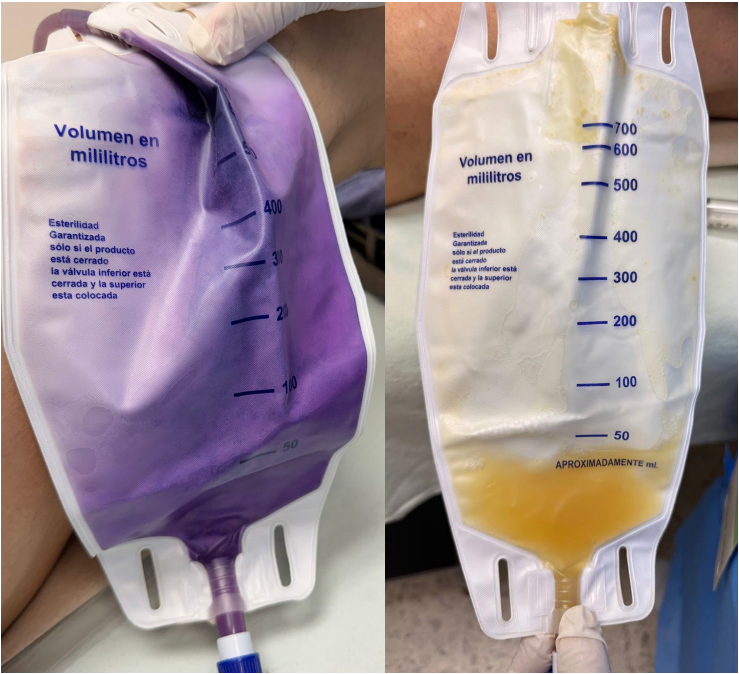
Legend: (Left) Characteristic purple discoloration predominantly affecting the synthetic plastic components of the urinary drainage system (catheter tubing and collection bag) rather than the freshly voided urine. (Right) Absence of discoloration following targeted antibiotic therapy and catheter replacement.
Ethical Approval and Informed Consent
Written informed consent for publication of this case report and accompanying anonymized images was obtained from the patient. The case was conducted in accordance with the ethical standards of the institutional and national research committees and with the 1964 Helsinki Declaration and its later amendments.
Discussion
Although PUBS is often considered a benign manifestation of asymptomatic bacterial colonization, in this patient it served as a prominent clinical feature of a chronic, recurrent, and symptomatic CA-UTI. Specifically, the patient met the clinical criteria for symptomatic infection through chronic catheterization, suprapubic pain, pyuria, bacteriuria, and culture growth of ESBL producing Proteus mirabilis. Furthermore, this case demonstrates that PUBS can manifest despite a measured acidic urine pH. Urinary pH measured in bulk urine may not reflect the physicochemical conditions at the catheter–biofilm interface, where pigment formation primarily occurs. Catheter-associated biofilms exhibit metabolic plasticity and can generate localized microenvironments, including pH variation driven by urease activity.6 Consequently, the enzymatic hydrolysis of indoxyl sulfate and subsequent oxidation of indoxyl likely occurred at the catheter surface or within the collection bag where bacterial density is maximal.7
Consistent with this mechanistic explanation, a systematic review found that approximately 6.9% of PUBS cases occur with urinary pH below 7.0.8 Our case is comparable to one reported by Chung et al. describing an 85 year old male with a chronic indwelling catheter and acidic urine (pH 5.5).9 Both patients were elderly men requiring long term catheterization, with benign prostatic hyperplasia in our patient and neurogenic bladder in the comparison case. While both patients shared the primary risk factor of chronic indwelling catheterization, their secondary profiles differed; the patient reported by Chung et al. was paraplegic with chronic constipation, whereas our patient remained mobile with regular bowel movements.
This case has two main limitations. First, molecular or enzymatic testing was not available to confirm phosphatase and sulfatase production by the isolated Proteus mirabilis. Second, empiric ciprofloxacin represents a therapeutic limitation. Despite the patient's long-term catheterization and high risk for resistant organisms (subsequently confirmed as ESBL-producing), optimal empiric therapy with intravenous carbapenems was constrained by outpatient management protocols. Because the patient's stable condition did not meet criteria for emergency hospital referral, we were unable to access broad-spectrum intravenous antibiotics.
Conclusion
This case emphasizes three clinical lessons. First, purple urine bag syndrome should prompt evaluation for urinary tract infection, as misinterpretation of urine discoloration may delay diagnosis. Second, the potential association with multidrug-resistant organisms reinforces the importance of culture-guided antimicrobial therapy in catheter-associated infections. Third, and most significantly, this case expands the recognized clinical spectrum of PUBS by documenting its occurrence in a chronically catheterized male patient with measured acidic urine and no history of constipation.
Conflict of Interest Statement & Funding
The Authors have no funding, financial relationships or conflicts of interest to disclose.
Author Contributions
Conceptualization: PV. Data Curation: RA. Investigation: RA. Methodology: PV. Project Administration: PV. Writing - Original Draft: PV, RA. Writing - Review Editing: PV, RA.
References
1. Barlow GB, Dickson JAS. PURPLE URINE BAGS. The Lancet. 1978 Jan 28;311(8057):220–1.
2. Khan F, Chaudhry MA, Qureshi N, Cowley B. Purple urine bag syndrome: an alarming hue? A brief review of the literature. Int J Nephrol. 2011;2011:1–3.
3. Dealler SF, Hawkey PM, Millar MR. Enzymatic degradation of urinary indoxyl sulfate by Providencia stuartii and Klebsiella pneumoniae causes the purple urine bag syndrome. J Clin Microbiol. 1988;26(10):2152–6. doi:10.1128/jcm.26.10.2152-2156.1988
4. Hadano Y, Shimizu T, Takada S, Inoue T, Sorano S. An update on purple urine bag syndrome. Int J Gen Med. 2012;5:707. doi:10.2147/IJGM.S35320.
5. Sabanis N, Paschou E, Papanikolaou P, Zagkotsis G. Purple Urine Bag Syndrome: More Than Eyes Can See. Curr Urol. 2019 Nov 1;13(3):125.
6. Yu Y, Singh H, Tsitrin T, Bekele S, Lin YH, Sikorski P, et al. Urethral Catheter Biofilms Reveal Plasticity in Bacterial Composition and Metabolism and Withstand Host Immune Defenses in Hypoxic Environment. Front Med (Lausanne). 2021 Jun 23;8:667462.
7. Bar-Or D, Rael LT, Bar-Or R, Craun ML, Statz J, Garrett RE. Mass spectrometry analysis of urine and catheter of a patient with purple urinary bag syndrome. Clinica Chimica Acta. 2007 Mar 1;378(1–2):216–8..
8. Yang HW, Su YJ. Trends in the epidemiology of purple urine bag syndrome: A systematic review. Biomed Rep. 2018 Mar 1;8(3):249.
9. Chung SD, Liao CH, Sun HD. Purple urine bag syndrome with acidic urine. Int J Infect Dis. 2008;12(5):526-527.
Paolo Vigne, 1 MD. Universidad Dr. José Matías Delgado, La Libertad, El Salvador.
Rodrigo Aparicio, 1 MD. Universidad Dr. José Matías Delgado, La Libertad, El Salvador.
About the Author: Paolo Vigne, MD, graduated from Universidad Dr. José Matías Delgado, La Libertad, El Salvador, in May 2025 from an eight-year medical program. He is a recipient of the Diploma de Honor al Mérito for achieving first place at the Eleventh Annual Poster Research Competition of the Faculty of Health Sciences “Dr. Luis Edmundo Vásquez”.
Correspondence: Paolo Vigne. Address: Km. 8 ½ Carretera a Santa Tecla, Antiguo Cuscatlán, La Libertad, El Salvador. Email: paolovigne@hotmail.com
Process: Peer-reviewed
Cite as Vigne P., Aparicio R. Purple Urinary Bag Syndrome in a Patient with Acidic Urine: A Case Report. Int J Med Stud. 2026 Apr-Jun;10[2]: 103-106.
© 2026 Paolo Vigne, Rodrigo Aparicio
This work is licensed under a Creative Commons Attribution 4.0 International License
International Journal of Medical Students, VOLUME 14, NUMBER 2, November 2026