Original Article
Association Between Diabetes Mellitus and Intraoperative Awareness During General Anesthesia: A Retrospective Cohort Study
Zhenghao Wang1, Ngoc Bich Nguyen2, Eduardo D. Espiridion3
doi: https://doi.org/10.5195/ijms.2026.3783
Volume 14, Number 2: 63-72
Received 14 08 2025; Rev-request 09 09 2025; Rev-request 20 11 2025; Rev-request 29 01 2026; Rev-recd 07 10 2025; Rev-recd 04 12 2025; Rev-recd 23 05 2026; Accepted 09 06 2026
ABSTRACT
Background:
Despite advancements in anesthetic techniques, specific patient populations remain vulnerable to intraoperative awareness. Diabetes mellitus (DM), increasingly prevalent and often accompanied by significant comorbidities, may complicate anesthetic management and mask signs of inadequate anesthetic depth. This study investigates whether DM is independently associated with an increased risk of unintended intraoperative awareness.
Methods:
A retrospective cohort analysis was conducted using the TriNetX research platform, a federated health database. Two cohorts were identified: patients with DM and a control group without DM undergoing surgery under general anesthesia (GA). Propensity-score matching (1:1) was used for demographics, comorbidity categories, procedure categories, and medication classes, with patients having cognitive impairment, chronic obstructive pulmonary disease, substance use disorder, cardiovascular disease or non-GA anesthetic technique excluded. The incidence of intraoperative awareness was compared between groups.
Results:
After matching, 189,787 patients were included in each cohort (total n=379,574). The incidence of intraoperative awareness was significantly higher in the DM group (0.027%, n=52) compared to the non-DM group (0.017%, n=32). DM was associated with a statistically significant increased risk (absolute risk difference: 0.011%, 95% CI: 0.001–0.02%, p=0.0291). This corresponds to a 62.5% higher relative risk of documented intraoperative awareness (RR=1.625, 95% CI: 1.046–2.524; OR=1.625, 95% CI: 1.046–2.524).
Conclusion:
DM was associated with a modestly higher relative risk, but a very small absolute difference, in documented intraoperative awareness. Given the observational design and residual imbalance in diabetes-related comorbidity, causality cannot be inferred. These findings support continued anesthetic vigilance in diabetic patients.
Introduction
Each year, more than 40 million patients in North America undergo anesthesia for surgical procedures.1 While the safety of anesthetic practice has improved substantially over recent decades, many of the molecular and physiological mechanisms underlying anesthetic action remain incompletely understood. This persistent knowledge gap limits the refinement of existing anesthetic agents and impedes the development of safer, more targeted alternatives. As with all pharmacologic therapies, anesthetics carry inherent limitations, contraindications, and potential adverse effects.
Intraoperative awareness, defined as the unintended recall of events during general anesthesia, is one of the most psychologically distressing and clinically significant complications of anesthetic care.2 Although rare, its consequences can be profound, often including post-traumatic stress disorder, persistent anxiety, and long-term mistrust of medical systems.2 The reported incidence of intraoperative awareness varies widely, ranging from 0.006% to 1%, depending on the methodology used. For instance, patient-reported data suggests an incidence of 1–2 per 1,000 anesthetics, while anesthesiologist-reported estimates are as low as 1 in 15,000.3 This discrepancy may reflect under recognition by providers, as many patients report awareness days or weeks after surgery, often only during preoperative assessments for future procedures.3 These findings underscore the inadequacy of current detection methods and highlight the need for systematic postoperative evaluations.
Numerous risk factors for intraoperative awareness have been identified. Pediatric patients exhibit significantly higher risk, up to 8 to 10 times that of adults, likely due to rapid redistribution of anesthetics and reduced effective plasma concentrations.4,5 Other recognized patient-related risk factors include high American Society of Anesthesiologists physical status (III or above), chronic alcohol or opioid use, and the need to limit anesthetic depth in settings of cardiovascular instability or severe obesity.1,6-8 The use of neuromuscular blockers further elevates risk by masking motor responses that typically serve as warning signs of inadequate anesthesia.9 Conversely, benzodiazepines offer a protective effect by promoting amnesia.10 Notably, obesity has emerged as a relevant concern not only for its pharmacokinetic complexity but also because it is highly prevalent among high-risk populations, over 90% of individuals with type 2 diabetes are overweight or obese, suggesting a potential link between diabetes and anesthesia-related complications.11
Diabetes mellitus (DM), which affects approximately 13% of adults in the United States (U.S), is a prevalent and clinically multifaceted comorbidity among surgical patients.12 Beyond its association with obesity, DM often coexists with cardiovascular disease, hypertension, dyslipidemia, and chronic kidney disease (CKD), each of which complicates anesthetic management.11 Moreover, DM-related autonomic neuropathy may blunt sympathetic responses to inadequate anesthesia, masking key physiological indicators such as changes in heart rate or blood pressure.11,13 In parallel, diabetic gastroparesis may delay gastric emptying, affecting the timing and absorption of anesthetic agents, while obstructive sleep apnea and reduced ventilatory reserve further challenge intraoperative monitoring.11 Together, these factors may obscure conventional markers of anesthetic depth and compromise the anesthesiologist’s ability to detect and prevent intraoperative awareness.
Despite the theoretical and mechanistic rationale suggesting a potential link, the relationship between DM and intraoperative awareness remains poorly characterized in the existing literature. To address this gap, we conducted a retrospective cohort study to examine the association between DM and the incidence of intraoperative awareness during general anesthesia. Data were obtained from the TriNetX Research Platform, a federated health research network encompassing 72 healthcare organizations within the U.S. Collaborative Network. TriNetX houses more than 250 million de-identified patient records and provides comprehensive clinical data on demographics, diagnoses, procedures, laboratory results, and medication histories. By leveraging this large, real-world dataset, our study aims to clarify the potential association between diabetes and intraoperative awareness, thereby improving preoperative risk stratification, informing individualized anesthetic management, and guiding targeted strategies to enhance perioperative safety in this high-risk and growing patient population.
Methods
Data Set: This study was conducted using a retrospective cohort design with anonymized patient data extracted from the TriNetX research platform, a federated health research network comprising electronic health record (EHR) data from diverse healthcare organizations across the U.S.
Study Population: Two patient cohorts undergoing procedures requiring general anesthesia (GA) were established for comparative analysis: a diabetic cohort (patients who had at least one documented diagnosis of DM using the 10th version of the International Classification of Diseases codes (ICD-10 codes E08–E13) recorded in the EHR prior to the index surgery date) and a matched non-diabetic control cohort (patients without any documented diagnosis of DM (ICD-10 codes E08–E13) at any point prior to the surgical procedure date). Data were collected from June 2005 to June 2025, and the index event (time zero) was defined as the first recorded anesthetic encounter for each patient during the study period. In addition, diabetes status and all covariates were ascertained from the EHR record strictly prior to this index event. Patients were identified from EHR data based on predetermined inclusion and exclusion criteria within the TriNetX platform. Patients were required to meet all of the following conditions for inclusion:
- 1. Anesthesia Encounter: Documentation of anesthesia service codes (TriNetX anesthesia code 1002796) indicating anesthesia services.
- 2. General Anesthetic Medication Administration: Evidence of receiving at least one pharmacological agent strongly indicative of general anesthesia, including:
- i. Volatile anesthetics (sevoflurane, isoflurane, desflurane), OR
- ii. Neuromuscular blocking agents (succinylcholine, rocuronium, vecuronium), OR
- iii. Total intravenous anesthesia (TIVA), specifically a combination of propofol with remifentanil.
- 3. Surgical or Procedural Context: Underwent at least one invasive procedure frequently associated with GA within one day of documented anesthetic medication administration. Relevant procedures included cardiovascular, neurological, gastrointestinal, endocrine, musculoskeletal, maternity-related surgeries, and interventional radiological therapeutic procedures.
To more precisely attribute any association between DM and intraoperative awareness, patients were excluded from both cohorts if they had documented ICD-10 diagnoses prior to surgery of the following confounding conditions:
- 1. Cognitive impairment or dementia preventing postoperative recall
- 2. Chronic obstructive pulmonary disease
- 3. Active hepatitis
- 4. Alcohol dependence or abuse
- 5. History of myocardial infarction
- 6. Cerebrovascular accident
- 7. Transient ischemic attack
- 8. Coronary artery disease
- 9. Medication or drug abuse or dependence
- 10. Procedures performed explicitly under monitored anesthesia care (MAC), sedation-only, or regional anesthesia without general anesthesia documentation
The primary outcome was the documented occurrence of intraoperative awareness, identified by ICD-10-CM codes T88.53 (“Unintended awareness under general anesthesia”) or Z92.84 (“Personal history of unintended awareness under general anesthesia”), recorded either during the index anesthetic event or within a five-year window following the event. This time frame was selected to minimize underestimation of intraoperative awareness incidence and to capture frequently underreported or delayed documentation of intraoperative awareness that may still be temporally and clinically related to the original surgical procedure.3 (Figure 1).
Table 1.Baseline Demographic Characteristics of Diabetic and Non-Diabetic Patients Undergoing General Anesthesia Before and After Propensity-Score Matching
Legend: Values are reported as mean ± standard deviation for continuous variables and n (%) for categorical variables. Standardized mean differences (SMDs) are shown to evaluate covariate balance; SMD < 0.10 was considered indicative of adequate balance after matching.
Statistical Analysis: Descriptive statistics (frequencies and percentages) were calculated to summarize patient demographics and clinical characteristics within each cohort. Cohorts were balanced using a 1:1 propensity score matching approach to control for potential confounding factors. The TriNetX Analytics Platform performs cohort comparison and propensity-score matching as an integrated, automated procedure: the platform first compares the two cohorts across a comprehensive, predefined variable set that includes (i) demographic characteristics (age at index, sex, race, ethnicity); (ii) all 22 ICD-10 diagnostic chapters; (iii) TriNetX-defined Current Procedural Terminology (CPT) procedure categories (Anesthesia [1002796], Surgery [1003143], Pathology and Laboratory [1011136], Evaluation and Management [1013625], Medicine Services [1012569], Radiology [1010251], etc); and (iv) the full set of VA National Drug File medication classes (Central Nervous System, Cardiovascular, Autonomic, Respiratory, Gastrointestinal, Antimicrobials, Hormones, Blood products, and others). The platform then automatically identifies variables exhibiting significant pre-match differences using its built-in significance indicator, and enters only those flagged variables into the 1:1 greedy nearest neighbor propensity-score matching algorithm (caliper 0.1 standardized logit units, without replacement).14 The variables that were flagged and entered into matching are reported in full in Table 2 of the main manuscript with their pre- and post-match standardized mean differences. All outcome estimates, risk difference, risk ratio, and odds ratio with their associated 95% confidence intervals and p-values, were calculated directly from event counts in the propensity-score matched cohorts using the TriNetX analytics module. The platform computes the risk difference and its 95% confidence interval using unconditional (asymptotic) standard-error methods for the difference of two independent proportions, and computes risk ratio, odds ratio, and their corresponding 95% confidence intervals from the matched-cohort 2 × 2 contingency table using the standard large-sample estimators implemented in the platform. P-values for the comparison of incidence proportions are derived from the corresponding large-sample test statistic for two independent proportions.14 The incidence of intraoperative awareness was compared between the diabetic and non-diabetic cohorts. Baseline covariate balance between matched cohorts was assessed using standardized mean differences (SMD), as p-values from chi-square or t-tests can be misleading in very large samples.15 An SMD <0.1 was considered indicative of adequate balance.16 For outcome analyses, statistical significance and effect size were evaluated using risk differences, risk ratios, and odds ratios. All statistical analyses were conducted using the TriNetX analytics platform, with statistical significance defined as a p-value <0.05. This study was conducted and reported in accordance with the STROBE (Strengthening the Reporting of Observational Studies in Epidemiology) guidelines for observational cohort studies.
Results
In total, 1,787,558 patients who underwent general anesthesia met the inclusion criteria. After applying the exclusion criteria, 1,346,355 remained eligible for analysis. (Figure 1). Table 1 summarizes the baseline demographic characteristics of the study population before and after propensity-score matching. The age at index for diabetic cohort was 57.0 ± 15.1 years, whereas it was 57.4 ± 15.6 years in the non-diabetic cohort. Gender distribution was similar between groups, with females comprising 58.305% of the diabetic cohort and 58.335% of the non-diabetic cohort. … “Not Hispanic or Latino” (75.059% in the diabetic cohort vs. 75.574% in the non-diabetic cohort) and “White” (70.794% vs. 72.439%). (All demographic variables were well balanced between cohorts.
Table 2.Comparison of Clinical Comorbidities Between Diabetic and Non-Diabetic Patients Undergoing General Anesthesia Before and After Propensity-Score Matching
Legend: Values represent the proportion of each cohort with at least one diagnosis in the specified ICD-10 category. Standardized mean differences (SMDs) are reported to assess balance in comorbidity burden; SMD < 0.10 after matching indicates excellent balance between cohorts.
To isolate DM as an independent risk factor for intraoperative awareness, propensity-score matching also accounted for clinical comorbidities between cohorts. Before matching, there were significant imbalances in several diagnostic categories, including neoplasms, infectious diseases, skin and subcutaneous tissue disorders, and blood-related disorders. Following matching, these differences were substantially minimized or eliminated, with post-match distributions in categories such as neoplasms, skin disorders, infectious diseases, diseases of the blood, and eye diseases nearly identical across cohorts. This matching strategy effectively reduced the influence of non-DM-related comorbidities, allowing for a cleaner assessment of DM as an independent variable. (Table 2)
In total, 1,346,355 patients who underwent general anesthesia were identified for inclusion in this analysis. After propensity-score matching, two balanced cohorts were established, each comprising 189,787 patients with and without DM, respectively. As shown in Figure 2, intraoperative awareness under general anesthesia was identified in 52 patients (0.027%) in the DM cohort and 32 patients (0.017%) in the non-DM cohort, corresponding to an absolute risk difference of 0.011% (95% CI: 0.001%–0.020%, p = 0.0291). The risk ratio (RR) and odds ratio (OR) were both 1.625 (95% CI: 1.046–2.524), indicating increased risk of intraoperative awareness in patients with DM compared to those without. To address hidden confounders, an E-value analysis was carried out, yielding 2.63 as the point estimate based on the RR, and 1.27 as the lower bound of the confidence interval. Baseline characteristics were well balanced after propensity matching, with all standardized mean differences < 0.1 (Table 1). For comorbidity categories, most non-endocrine diagnostic groups were also well balanced, whereas larger standardized mean differences persisted for the broad endocrine/metabolic, circulatory, and genitourinary categories, reflecting the expected higher burden of diabetes-related conditions in the diabetic cohort (Table 2). The full pre-matching distribution across all CPT procedure categories and Veterans Affairs (VA) drug classification system that TriNetX compared but did not select for matching are included in Supplementary Table S1.
These findings demonstrate a robust and statistically significant association between DM and an increased risk of intraoperative awareness under general anesthesia, even after rigorous control for demographic and clinical confounders (Figure 3 and Table 2).
Figure 1.Selection Criteria for Retrospective Cohort Study
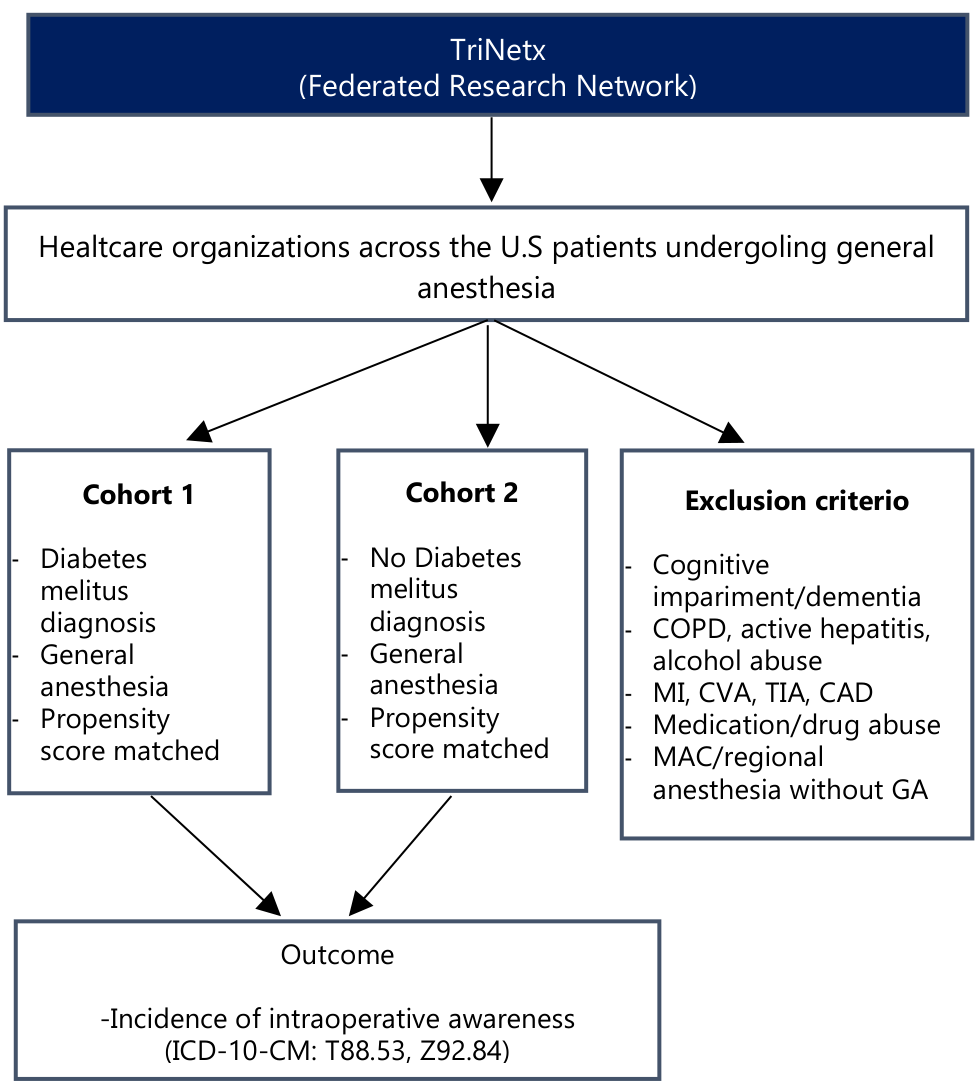
Legend: Flow diagram of cohort selection from the TriNetX U.S. Collaborative Network (2005–2025). Patients receiving general anesthesia were identified, with MAC and regional-only cases excluded. After applying predefined inclusion/exclusion criteria and removing confounders, patients were categorized into diabetic and non-diabetic groups. A 1:1 propensity-score matching procedure produced balanced, equally sized cohorts for outcome analysis.
Figure 2.Overall Outcome of Intraoperative Awareness in Diabetic vs. Non-Diabetic Patients Undergoing General Anesthesia
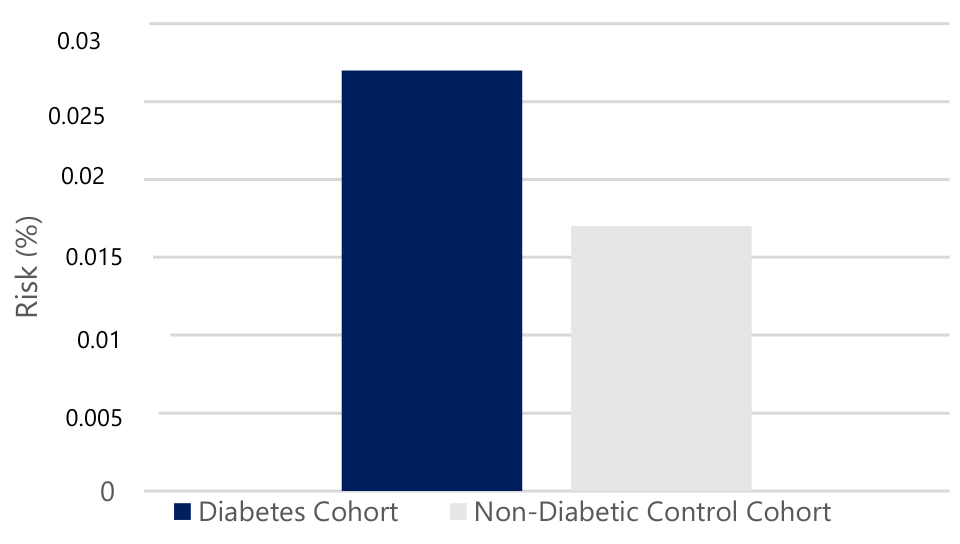
Legend: Bars represent the number and percentage of patients with documented intraoperative awareness in each cohort after propensity-score matching. Intraoperative awareness occurred in 52 diabetic patients (0.027%) and 32 non-diabetic patients (0.017%), illustrating the higher incidence in the diabetic cohort.
Discussion
This study evaluated the association between DM and the risk of intraoperative awareness during general anesthesia, demonstrating that DM is associated with a significantly increased risk. As shown in Figure 3, the risk ratio for intraoperative awareness in diabetic patients was 1.625 (95% CI: 1.046–2.524), with a corresponding odds ratio of 1.625 (95% CI: 1.046–2.524; p = 0.0291). While this represents a 62.5% higher relative risk of intraoperative awareness among patients with diabetes, the absolute difference between groups was minimal, 0.027% in the diabetic cohort compared to 0.017% in the non-diabetic cohort, corresponding to an absolute risk difference of 0.011% (95% CI: 0.001%–0.020%, p = 0.0291).
Figure 3.Incidence and Relative Risk of Intraoperative Awareness in Diabetic vs. Non-Diabetic Patients Undergoing General Anesthesia
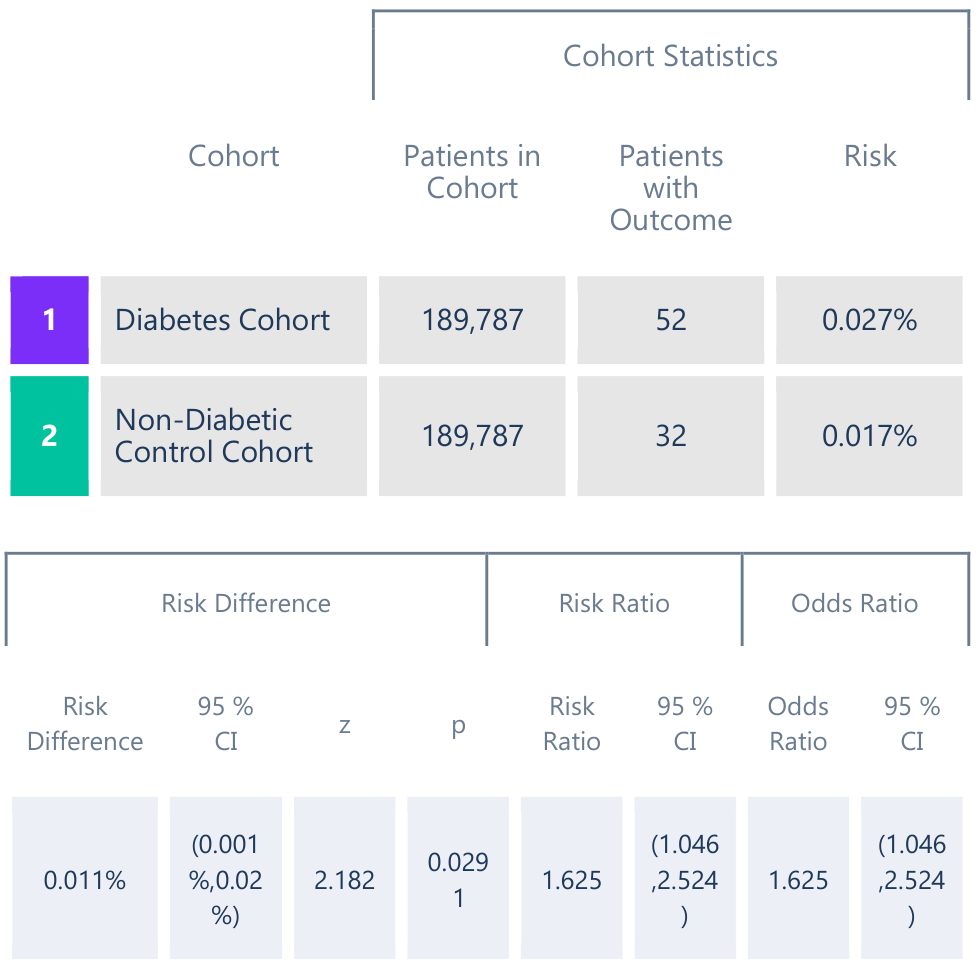
Legend: This figure summarizes the overall incidence of intraoperative awareness and the corresponding relative risk comparing diabetic and non-diabetic patients after propensity-score matching. Diabetic patients experienced 52 awareness events (0.027%) compared with 32 (0.017%) in the non-diabetic cohort, corresponding to a relative risk of 1.625 (95% CI, 1.046–2.524).
In absolute terms, the unrounded risk difference (52 − 32 = 20 additional events among 189,787 patients per cohort; 0.0105%) corresponds to approximately 10.5 additional documented cases per 100,000 anesthetics. Its reciprocal, often reported as a number needed to harm, is approximately 9,489. This contextualizes the clinical magnitude of the finding: one additional case of intraoperative awareness would be expected for every 9,489 diabetic patients receiving general anesthesia. To provide comparison, this absolute increase remains less frequent as compared to the risk of having perioperative anaphylaxis and failed intubation, which are 1 in 6,531 and 1 in 3,057 respectively.17,18
This small absolute difference underscores that intraoperative awareness remains a rare phenomenon in both populations. Nonetheless, the finding carries clinical relevance because awareness, though infrequent, can have severe psychological and medicolegal consequences. Thus, these results should be interpreted as emphasizing the importance of recognizing and mitigating subtle, patient-specific Dashes become commas: “risk factors, such as those associated with diabetes, rather than suggesting a substantial change in overall anesthetic practice. In everyday anesthetic application, the implications lie in targeted vigilance: ensuring adequate depth of anesthesia, particularly in patients whose metabolic or neurologic alterations may influence anesthetic pharmacodynamics.
Several pathophysiologic mechanisms may underlie the increased susceptibility to intraoperative awareness observed among diabetic patients. Chronic hyperglycemia and metabolic dysregulation can lead to diabetic autonomic neuropathy, which blunts physiological responses, such as tachycardia and hypertension, to inadequate anesthesia, masking clinical indicators of insufficient anesthetic depth.19 Gastroparesis, a common manifestation of autonomic dysfunction, delays gastric emptying and may reduce the absorption of preoperative oral sedatives and anxiolytics, decreasing their bioavailability and effectiveness.11 Moreover, DM is associated with widespread microvascular complications that impair capillary blood flow and tissue perfusion.20 These changes can alter the pharmacokinetics of anesthetic agents by reducing their distribution efficiency and delaying equilibration with central compartments, including the central nervous system. As a result, anesthetic agents may reach subtherapeutic concentrations in target tissues, which could increase the risk of intraoperative awareness.
The clinical implications of intraoperative awareness are substantial, with potential long-term consequences including post-traumatic stress disorder, anxiety, and avoidance of future healthcare encounters, which can negatively impact patient outcomes and quality of life.2 Given the rising global prevalence of DM, these findings highlight the need for heightened vigilance and personalized anesthetic strategies in this high-risk population.
Since autonomic signs may be unreliable in diabetic patients, anesthesiologists should consider incorporating objective depth-of-anesthesia monitoring tools, such as bispectral index monitoring, which utilizes electroencephalogram data to assess consciousness levels and allows real-time anesthetic adjustment.21 This approach may help mitigate the risk of awareness in patients with DM. Furthermore, neuromuscular blocking agents (NMBAs), while often necessary for surgical procedures, are associated with an increased risk of awareness due to their suppression of motor responses, which are often used as indirect signs of consciousness.9 While it may not always be feasible to avoid NMBA use, clinicians should minimize their dosage where appropriate and ensure that depth of anesthesia is adequately maintained when paralysis is required.
Several strengths of this study warrant emphasis. The analysis focused on a single, predefined primary outcome, the incidence of intraoperative awareness, thereby minimizing the risk of Type I error due to multiple analyses. The use of 1:1 propensity-score matching across demographic and clinical variables, combined with a matched sample of nearly 380,000 patients, provided robust statistical power to detect the observed association while controlling for measured confounders. Given that the data from TriNetX were derived from the U.S Collaborative Network, the patient population was sufficiently diverse and nationally representative, supporting the generalizability of these findings across a wide range of healthcare settings.
The exclusion of patients with cardiovascular disease, including coronary artery disease, prior myocardial infarction, and cerebrovascular accident, warrants specific justification. We recognize that these conditions are downstream sequelae of diabetes and, within a strict causal framework, sit on the mediating pathway between diabetes and intraoperative awareness rather than acting as confounders. Our rationale for excluding them was not to control confounding but to limit heterogeneity in anesthetic technique. In patients with significant cardiovascular or cerebrovascular disease, anesthesiologists frequently and intentionally deliver lighter, hemodynamically tailored anesthesia to preserve perfusion pressure.22 This independently elevates the risk of intraoperative awareness through a mechanism unrelated to diabetes. Similarly, patients with chronic obstructive pulmonary disease (COPD) and active hepatitis were excluded for two reasons rooted in anesthetic pharmacology. COPD alters pulmonary uptake and elimination of inhaled volatile anesthetics through ventilation-perfusion mismatch and air trapping, producing less predictable anesthetic kinetics.23 These pharmacokinetic complexities, combined with heightened concern for postoperative respiratory complications, may influence anesthetic management in ways that could increase the risk of intraoperative awareness.24 As for active hepatitis, it impairs hepatic metabolism and clearance of intravenous anesthetic agents, resulting in unpredictable plasma concentration.25 Additionally, patients with cognitive impairment or dementia were excluded due to the potential for unreliable postoperative recall, which could compromise the accuracy of intraoperative awareness reporting.
We acknowledge that this exclusion strategy limits the generalizability of our findings to the broader surgical population, in which cardiovascular comorbidity is common among diabetic patients. The estimate reported here should therefore be interpreted as the association between diabetes and intraoperative awareness independent of established macrovascular complications, rather than the total effect of diabetes inclusive of its cardiovascular sequelae.
Our findings should be interpreted in light of several methodological limitations inherent to the data source and study design. Propensity score matching effectively reduced measurable differences between cohorts, with the exception of three system categories endocrine/metabolic (post-matching SMD 0.9456), circulatory (SMD 0.5140), and genitourinary (SMD 0.1546) diseases. The endocrine/metabolic imbalance is largely structural as diabetes itself is coded within ICD-10 chapter E00–E89, so every patient in the diabetic cohort carries a code in this category and it cannot be balanced against a non-diabetic control cohort. These conditions frequently co-occur with diabetes, therefore, full adjustment for these conditions is not feasible because doing so would remove core clinical features of the diabetic population and lead to overmatching, where controlling for downstream consequences of diabetes masks the very pathways through which DM may influence anesthetic risk. Consequently, residual confounding remains possible, particularly from comorbidities closely linked to DM that were not comprehensively controlled for, such as chronic kidney disease (CKD) and obesity. CKD can significantly alter anesthetic pharmacokinetics and pharmacodynamics by impairing drug metabolism and clearance, thereby prolonging anesthetic effects. Similarly, obesity— which is common among patients with DM, affects drug distribution, cardiac output, and monitoring reliability, all of which may influence anesthetic depth. While these comorbidities may partially contribute to the observed association between DM and intraoperative awareness, eliminating them from analysis would distort the real world diabetic phenotype and undermine external validity. To assess the effect of unmeasured confounding factors, an E-value analysis was conducted. An E-value of 2.63 was calculated from the risk ratio of 1.625, which indicates that a relatively strong unmeasured confounder would be required to fully explain away the association. For the lower bound of the 95% CI of 1.046, an E-value of 1.27 was calculated, which suggests that it may be more sensitive to residual confounding. Accordingly, the estimate should be interpreted as the association between diagnosed DM, together with its frequently co-occurring circulatory and genitourinary (including renal) comorbidity, and documented intraoperative awareness, rather than as an isolated effect of DM Future studies using detailed perioperative data may help clarify the extent to which these intertwined comorbidities modify this relationship.
Another important limitation arises from reliance on ICD-10-CM coding within the TriNetX database to detect intraoperative awareness events. This approach likely underestimates the true incidence, as awareness episodes are often recognized only through structured postoperative interviews or narrative clinical documentation rather than formal billing codes.
Two limitations relate to the operational definitions used to construct the cohort. First, the non-diabetic cohort was defined by the absence of an ICD-10 E08–E13 diagnosis prior to surgery and may therefore include patients with undiagnosed diabetes or prediabetes. We considered tightening this definition by excluding patients with abnormal Hemoglobin A1c values or exposure to antidiabetic medications, but neither criterion could be applied reliably within TriNetX. HbA1c results are not consistently captured or harmonized across the federated network, and antidiabetic agents, particularly metformin, glucagon-like peptide-1 agonists, and sodium-glucose co-transporter 2 inhibitors, are increasingly prescribed for non-diabetic indications including polycystic ovary syndrome, obesity, and heart failure, which would have introduced a new layer of misclassification rather than resolving the existing one. We therefore retained the conservative ICD-based definition. Any undiagnosed diabetes or prediabetes contamination of the control cohort would be expected to bias the observed association toward the null. Second, the operational definition of general anesthesia exposure required three concurrent criteria: an anesthesia service code, administration of a qualifying anesthetic agent, and a temporally proximate invasive procedure. However, the algorithm could not be validated against the structured anesthetic record, as TriNetX does not provide depth-of-anesthesia documentation, end-tidal volatile concentrations, or processed-electroencephalogram (EEG) values. Residual exposure misclassification therefore cannot be excluded, particularly at the boundary between general anesthesia and deep sedation, and heterogeneity in anesthetic depth within the cohort remains unmeasured. Future work using institutional datasets with linked anesthesia records will allow direct validation of this exposure algorithm and the application of more restrictive definitions to assess the robustness of the present findings.
The capture of intraoperative awareness events is also constrained by the database. Detection in this study relied on ICD-10-CM coding, which likely underestimates the true incidence. This is because awareness episodes are typically recognized through structured postoperative interviews or narrative clinical documentation rather than formal billing codes, and TriNetX does not provide access to anesthesia records, postoperative interviews, or intraoperative monitoring data. Moreover, patients may not immediately recognize or report their experiences, and even when reported, these events are not uniformly coded across providers or institutions, leading to variability. Coding practices also differ across health systems, even when awareness is documented in chart notes, causing additional under detection of cases. Variability in ICD-10-CM coding practices across institutions may produce non-differential misclassification of both exposure (DM) and outcome (intraoperative awareness). Temporal misclassification is also possible, as awareness episodes may be recorded outside of the 5 year window after the index anesthetic, and these delayed entries may not be consistently included in the study. Consequently, these lead to a fraction of true awareness events undetected. The possibility of differential outcome ascertainment must also be discussed: patients with fewer post-index encounters had fewer opportunities for an awareness diagnosis to be recorded, which would bias the observed incidence downward. Diabetic patients, however, typically require more frequent healthcare contact than non-diabetic controls, which could disproportionately increase awareness capture in the exposed cohort and bias the effect estimate upward. The net direction of these competing biases is uncertain, although the bidirectional pull suggests the observed association is unlikely to be explained by ascertainment differences alone. For our study, no minimum post-index follow-up duration was required for cohort eligibility, as the TriNetX platform does not provide patient-level data that would permit the restriction.
Several structural features of the TriNetX platform also restricted our analysis. The network aggregates data from 72 healthcare organizations with variable documentation practices, differences in perioperative management and site-level heterogeneity may vary. Robust or cluster-robust standard errors accounting for institutional correlation are not available because TriNetX does not expose the contributing institution as a patient-level identifier. As an EHR-derived dataset, TriNetX also does not capture several variables that are clinically relevant to intraoperative awareness risk, including American Society of Anesthesiologists (ASA) physical status, emergency vs elective surgical designation, exact procedure duration, intraoperative anesthetic dose, processed-EEG/bispectral index monitoring, intraoperative anesthetic depth, anesthesia provider experience and training, and institution-level practice patterns. Therefore, these variables could not be matched on or adjusted for. The platform’s automated significance threshold may leave some compared-but-unflagged variables imbalanced at baseline (Supplementary Table S1), these variables are included for transparency. Finally, conditional logistic regression appropriate for matched-pair data is not implemented within the platform's standard analytics module and could not be applied through the access model used in this study. However, unconditional logistic regression has been argued to be appropriate for matched designs in which the matching is non-unique, that is, when one case could be matched to other controls without substantially changing the association. 1:1 nearest-neighbor propensity-score matching from a large control pool shares this non-unique structure, and the qualitative interpretation of the association is therefore unlikely to be substantively affected.26
The statistical inference rests on a matched-cohort 2 × 2 contingency table in which all four cells contain non-sparse observed counts (minimum cell count = 32) and the smallest expected count under the null hypothesis is 42 — well above the conventional threshold of 5 that motivates the use of small-sample methods. The asymptotic standard-error methods implemented in the TriNetX analytics module are therefore appropriate, and the small-sample concerns that motivate Firth-type penalization and exact methods, sparse cells, separation, or zero counts, do not arise here. These approaches would nonetheless be the appropriate inferential strategy in sparser data, such as analyses stratified by diabetes subtype (type 1 vs type 2), by anesthetic class, or within smaller surgical subpopulations. Neither Firth-corrected logistic regression nor exact (mid-P) methods is directly implemented within the TriNetX analytics module, and both require patient-level computation, which the federated platform does not permit. Future analyses with smaller event counts should employ these methods in datasets that allow patient-level statistical access.
Future research should further investigate whether the observed association differs between type 1 and type 2 diabetes mellitus (DM), given their distinct pathophysiologic mechanisms, age of onset, and comorbidity profiles, all of which may variably influence anesthetic pharmacodynamics, metabolism, and susceptibility to intraoperative awareness. In addition, future studies should incorporate richer phenotyping of diabetes, including repeat diagnostic codes, validated medication exposure, longitudinal A1c trajectories, and disease duration, to characterize a potential dose–response relationship between diabetes severity and intraoperative awareness. Such details would also permit meaningful subgroup analysis by glycemic control and insulin dependence, which our administrative dataset could not support. Although we attempted to perform subgroup analyses, the number of patients with type 1 DM experiencing intraoperative awareness in our dataset was insufficient for meaningful statistical comparison. Stratification by DM subtype and insulin-dependence in larger datasets may help clarify potential differences in anesthetic risk profiles.
Furthermore, while neuromuscular blocking agents (NMBAs) are well recognized to increase the risk of awareness by masking motor responses indicative of inadequate anesthesia, our ability to stratify awareness events based on NMBA exposure was constrained by the structure of the TriNetX database. Although the platform records medication exposures, it does not consistently include temporal data regarding dose, duration, or intraoperative context. Consequently, precise classification of NMBA administration was not feasible. Future studies that leverage more comprehensive perioperative datasets are needed to elucidate the relationship between NMBA use and intraoperative awareness, particularly among high-risk populations such as patients with diabetes.
Finally, further investigation in specific surgical subgroups, such as obstetric patients with gestational DM undergoing cesarean delivery, may inform tailored anesthetic and monitoring strategies, thereby enhancing perioperative safety for both mothers and infants.
Taken together, this large-scale study identified an association between DM and a modestly higher relative risk of documented intraoperative awareness These findings underscore the importance of individualized anesthetic planning, proactive intraoperative monitoring, and structured postoperative assessments in this high-risk population. Routine follow-up beyond the post-anesthesia care unit, including post-discharge contact or outpatient follow-up, may help identify delayed recall and enable timely intervention. Finally, although the data showed a statistically significant difference in incidence of anesthesia awareness between DM and non-DM patients, the absolute risk difference remained small at 0.011%. While this increase may appear modest in clinical practice given the rarity of the event, the findings nonetheless highlight the need for continued vigilance in anesthetic monitoring for patients with diabetes.
Acknowledgments
Drexel University College of Medicine and Tower Health Hospital.
Conflict of Interest Statement & Funding
The authors have no conflict of interests, funding or financing relationships to declare.
Author Contributions
Conceptualization: Z.W, N.B.N, E.E. Data Curation: Z.W, N.B.N. Formal Analysis: Z.W, N.B.N. Investigation: Z.W, N.B.N. Methodology: Z.W, N.B.N. Project Administration: Z.W, N.B.N. Supervision: E.E. Validation: E.E. Writing - Original Draft: Z.W, N.B.N. Writing - Review & Editing: Z.W, N.B.N.
References
1. Orser BA, Mazer CD, Baker AJ. Awareness during anesthesia. CMAJ. 2008 Jan 15;178(2):185–8.
2. Bischoff P, Rundshagen I. Awareness under general anesthesia. Dtsch Arztebl Int. 2011 Jan;108(1-2):1–7.
3. Pandit JJ, Cook TM, Jonker WR, O'Sullivan E. A national survey of anaesthetists (NAP5 Baseline) to estimate an annual incidence of accidental awareness during general anaesthesia in the UK. Anaesthesia. 2013 Apr;68(4):343–53.
4. Andrade J, Deeprose C, Barker I. Awareness and memory function during paediatric anaesthesia. Br J Anaesth. 2008 Mar;100(3):389–96.
5. Jöhr M. [Awareness: a problem in paediatric anaesthesia?] Anaesthesist. 2006 Oct;55(10):1041–9. German.
6. Houser CR, Esclapez M. Downregulation of the alpha5 subunit of the GABAA receptor in the pilocarpine model of temporal lobe epilepsy. Hippocampus. 2003;13(5):633–45.
7. Kim MC, Fricchione GL, Akeju O. Accidental awareness under general anaesthesia: incidence, risk factors, and psychological management. BJA Educ. 2021 Apr;21(4):154–61.
8. Liang J, Cagetti E, Olsen RW, Spigelman I. Altered pharmacology of synaptic and extrasynaptic GABAA receptors on CA1 hippocampal neurons is consistent with subunit changes in a model of alcohol withdrawal and dependence. J Pharmacol Exp Ther. 2004 Sep;310(3):1234–45.
9. Sandin RH, Enlund G, Samuelsson P, Lennmarken C. Awareness during anaesthesia: a prospective case study. Lancet. 2000 Feb 26;355(9205):707–11.
10. Errando CL, Sigl JC, Robles M, Calabuig E, García J, Arocas F, et al. Awareness with recall during general anaesthesia: a prospective observational evaluation of 4001 patients. Br J Anaesth. 2008 Aug;101(2):178–85.
11. Cornelius BW. Patients with type 2 diabetes: anesthetic management in the ambulatory setting. Part 1: pathophysiology and associated disease states. Anesth Prog. 2016;63(4):208–15.
12. Sheehy AM, Gabbay RA. An overview of preoperative glucose evaluation, management, and perioperative impact. J Diabetes Sci Technol. 2009 Nov;3(6):1261–9.
13. Domino KB, Posner KL, Caplan RA, Cheney FW. Awareness during anesthesia: a closed claims analysis. Anesthesiology. 1999 Apr;90(4):1053–61.
14. Nunes RAB, Neves PDMM, da Costa LMA, Bachour P, Cantarelli MJC, Oliveira GBF, et al. Five-year cardiovascular outcomes in patients with chronic myeloid leukemia treated with tyrosine kinase inhibitors. Front Cardiovasc Med. 2023 Feb;10:888366.
15. Austin PC. Balance diagnostics for comparing the distribution of baseline covariates between treatment groups in propensity-score matched samples. Stat Med. 2009 Sep 20;28(25):3083–107.
16. Zhang Z, Kim HJ, Lonjon G, Zhu Y; written on behalf of AME Big-Data Clinical Trial Collaborative Group. Balance diagnostics after propensity score matching. Ann Transl Med. 2019 Jan;7(1):16.
17. Gonzalez-Estrada A, Carrillo-Martin I, Renew JR, Rank MA, Campbell RL, Volcheck GW. Incidence of and risk factors for perioperative or periprocedural anaphylaxis in the United States from 2005 to 2014. Ann Allergy Asthma Immunol. 2021 Feb;126(2):180-6.e3.
18. Jayaraj AK, Siddiqui N, Abdelghany SMO, Balki M. Management of difficult and failed intubation in the general surgical population: a historical cohort study in a tertiary care centre. Can J Anaesth. 2022 Apr;69(4):427-437.
19. Vinik AI, Erbas T, Casellini CM. Diabetic cardiac autonomic neuropathy, inflammation and cardiovascular disease. J Diabetes Investig. 2013 Jan;4(1):4–18.
20. Vithian K, Hurel S. Microvascular complications: pathophysiology and management. Clin Med (Lond). 2010 Oct;10(5):505–9.
21. Punjasawadwong Y, Phongchiewboon A, Boonjeungmonkol N. Bispectral index (BIS) monitor for improving anaesthetic delivery and postoperative recovery. Cochrane 2014 Jun;(6):CD003843..
22. Lewis SR, Pritchard MW, Fawcett LJ, Punjasawadwong Y. Bispectral index for improving intraoperative awareness and early postoperative recovery in adults. Cochrane Database Syst Rev. 2019 Sep;(9):CD003843.
23. Gunnarsson L, Tokics L, Lundquist H, Brismar B, Strandberg A, Berg B, Hedenstierna G. Chronic obstructive pulmonary disease and anaesthesia: formation of atelectasis and gas exchange impairment. Eur Respir J. 1991 Oct;4(9):1106-1116.
24. Licker M, Schweizer A, Ellenberger C, Tschopp JM, Diaper J, Clergue F. Perioperative medical management of patients with COPD. Int J Chron Obstruct Pulmon Dis. 2007;2(4):493-515.
25. McLean AJ, Morgan DJ. Clinical pharmacokinetics in patients with liver disease. Clin Pharmacokinet. 1991 Jul;21(1):42-69.
26. Kuo CL, Duan Y, Grady J. Unconditional or conditional logistic regression model for age-matched case-control data? Front Public Health. 2018 Mar 2; 6:57.
Zhenghao Wang, 1 BA. Third-year Medical Student. Drexel University College of Medicine, West Reading, Pennsylvania, USA.
Ngoc Bich Nguyen, 2 BS. Third-year Medical Student. Drexel University College of Medicine, West Reading, Pennsylvania, USA.
Eduardo D. Espiridion, 3 MD. Department of Psychiatry, Tower Health Hospital, West Reading, Pennsylvania, USA.
About the Author: Zhenghao Wang and Ngoc Bich Nguyen are third-year medical students at Drexel University College of Medicine in West Reading, USA. Zhenghao Wang, a first-generation immigrant and college graduate, is committed to advancing health equity. He earned a Bachelor of Arts in Cell Biology with cum laude honors from Boston University, where he also completed an honors research project—experiences that fuel his passion for medicine and research. Ngoc Bich is also a first-generation immigrant, driven by a strong commitment to patient-centered advocacy, advancing medical research, and addressing health disparities in underserved communities.
Correspondence: Zhenghao Wang. Address: 50 Innovation Way, Wyomissing, PA 19610, USA. Email: zw458@drexel.edu (
Process: Peer-reviewed
Supplementary Material
Supplementary Table S1:Pre-Matching Cohort Comparison Across Procedure and Medication Variables by the TriNetX
Legend: : Procedure and medication variables compared at baseline but not selected for propensity-score matching by the TriNetX Signal indicator. Not being selected does not indicate statistical similarity. *Δ (pp) denotes the difference in cohort proportions (Diabetes minus Non-Diabetic), in percentage points.
Cite as Wang Z, Nguyen NB, Espiridion ED. Association Between Diabetes Mellitus and Intraoperative Awareness During General Anesthesia: A Retrospective Cohort Study. Int J Med Stud. 2026 Apr-Jun;14(2): 63-72.
© 2026 Zhenghao Wang, Ngoc Bich Nguyen, Eduardo D. Espiridion
This work is licensed under a Creative Commons Attribution 4.0 International License
International Journal of Medical Students, VOLUME 14, NUMBER 2, November 2026