Port-a-Cath Fragmentation Causing Recurrent Chest Pressure and Dizziness in an Elderly Man: A Case Report
DOI:
https://doi.org/10.5195/ijms.2025.3234Keywords:
Dizziness, Hypertension, Pulmonary artery, Radiology Interventional, Case Report, Port-a-catheter, Fluoroscopic retrieval, Follicular lymphoma, Pulmonary artery embolization, Pulmonary hypertension symptomsAbstract
Background: A port-a-catheter is a long-term vascular access device designed for patients requiring prolonged access to a large venous vessel. These devices are typically surgically inserted into the internal jugular vein, subclavian vein, or superior vena cava.
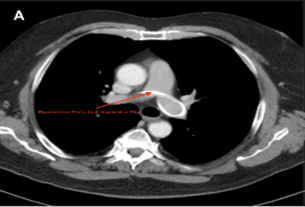
Case: A 71-year-old male with a history of follicular lymphoma in remission following treatment with six cycles of rituximab, cyclophosphamide, doxorubicin, vincristine, and prednisone (R-CHOP) presented with a 10-week history of intermittent chest pressure and dizziness. During a routine follow-up visit with his oncologist, a screening computed tomography (CT) scan revealed a fragmented port-a-catheter. The catheter fragment was coiled within the right and left main pulmonary arteries. The patient underwent fluoroscopic-guided retrieval of the fragment, resulting in complete resolution of his symptoms.
Conclusion: Fractured port-a-catheters can migrate to the pulmonary arteries, leading to increased pulmonary pressure and irritation of the pulmonary endothelium. This can manifest as chest discomfort, chest pressure, dizziness, and episodic hypertensive emergencies. Prompt recognition, confirmation with imaging, and retrieval of the fractured catheter are crucial to prevent serious complications. Physicians should consider catheter fragmentation and migration as possible causes when diagnosing patients with similar symptoms who have a known indwelling port.
References
1. Khalid SI, Maasarani S, Shanker RM, Wiegmann AL, Wu R, Skertich NJ, et al. Outcomes following port-a-catheter placement in the Medicare population. Surg Open Sci. 2021 Jan;3:39–43.
2. Li Y, Guo J, Zhang Y, Kong J. Intravascular treatment for abnormal catheter positioning of Port-a-cath system in the subclavian vein: a single-center study. J Interv Med. 2022 May;5(2):103–10.
3. Subramaniam A, Kim KH, Bryant SA, Kimball KJ, Huh WK, Straughn JM, et al. Incidence of mechanical malfunction in low-profile subcutaneous implantable venous access devices in patients receiving chemotherapy for gynecologic malignancies. Gynecol Oncol. 2011 Oct;123(1):54–7.
4. Debets JM, Wils JA, Schlangen JT. A rare complication of implanted central-venous access devices: catheter fracture and embolization. Support Care Cancer. 1995 Nov;3(6):432–4.
5. Lin C, Wu H, Chan D, Hsieh C, Huang M, Yu J. The mechanisms of failure of totally implantable central venous access system: analysis of 73 cases with fracture of catheter. Eur J Surg Oncol. 2010 Jan;36(1):100–3.
6. Li Y, Chen J, Li Z, Lu H, Ren K, Ren J, et al. Successful percutaneous transvenous retrieval of intravascular fractured port catheter: a single center experience. J Cardiothorac Surg. 2020 May 18;15(1).
7. Hainsworth R. Cardiovascular control from cardiac and pulmonary vascular receptors. Exp Physiol. 2013 Oct;99(2):312–9.
Downloads
Published
How to Cite
License
Copyright (c) 2025 Tyler Tepfenhart, Callie Fort, Marcel Twahirwa, Bryce Jensen

This work is licensed under a Creative Commons Attribution 4.0 International License.
Authors who publish with this journal agree to the following terms:
- The Author retains copyright in the Work, where the term “Work” shall include all digital objects that may result in subsequent electronic publication or distribution.
- Upon acceptance of the Work, the author shall grant to the Publisher the right of first publication of the Work.
- The Author shall grant to the Publisher and its agents the nonexclusive perpetual right and license to publish, archive, and make accessible the Work in whole or in part in all forms of media now or hereafter known under a Creative Commons Attribution 4.0 International License or its equivalent, which, for the avoidance of doubt, allows others to copy, distribute, and transmit the Work under the following conditions:
- Attribution—other users must attribute the Work in the manner specified by the author as indicated on the journal Web site; with the understanding that the above condition can be waived with permission from the Author and that where the Work or any of its elements is in the public domain under applicable law, that status is in no way affected by the license.
- The Author is able to enter into separate, additional contractual arrangements for the nonexclusive distribution of the journal's published version of the Work (e.g., post it to an institutional repository or publish it in a book), as long as there is provided in the document an acknowledgment of its initial publication in this journal.
- Authors are permitted and encouraged to post online a prepublication manuscript (but not the Publisher’s final formatted PDF version of the Work) in institutional repositories or on their Websites prior to and during the submission process, as it can lead to productive exchanges, as well as earlier and greater citation of published work. Any such posting made before acceptance and publication of the Work shall be updated upon publication to include a reference to the Publisher-assigned DOI (Digital Object Identifier) and a link to the online abstract for the final published Work in the Journal.
- Upon Publisher’s request, the Author agrees to furnish promptly to Publisher, at the Author’s own expense, written evidence of the permissions, licenses, and consents for use of third-party material included within the Work, except as determined by Publisher to be covered by the principles of Fair Use.
- The Author represents and warrants that:
- the Work is the Author’s original work;
- the Author has not transferred, and will not transfer, exclusive rights in the Work to any third party;
- the Work is not pending review or under consideration by another publisher;
- the Work has not previously been published;
- the Work contains no misrepresentation or infringement of the Work or property of other authors or third parties; and
- the Work contains no libel, invasion of privacy, or other unlawful matter.
- The Author agrees to indemnify and hold Publisher harmless from the Author’s breach of the representations and warranties contained in Paragraph 6 above, as well as any claim or proceeding relating to Publisher’s use and publication of any content contained in the Work, including third-party content.
Enforcement of copyright
The IJMS takes the protection of copyright very seriously.
If the IJMS discovers that you have used its copyright materials in contravention of the license above, the IJMS may bring legal proceedings against you seeking reparation and an injunction to stop you using those materials. You could also be ordered to pay legal costs.
If you become aware of any use of the IJMS' copyright materials that contravenes or may contravene the license above, please report this by email to contact@ijms.org
Infringing material
If you become aware of any material on the website that you believe infringes your or any other person's copyright, please report this by email to contact@ijms.org